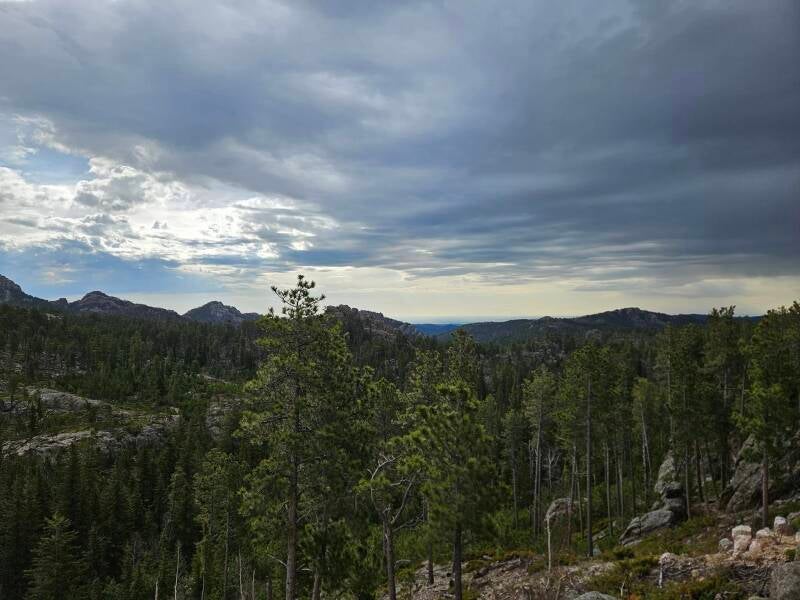
Black Hills of South Dakota along the Needles Highway
I don't know about you, but during this decade of the century it feels like we're quick to believe every piece of information like headlines, internet posts and so forth that comes across our feed. The most common phrase I hear uttered is "Well, so and so said that, so it's OBVIOUSLY true!". Then, when someone succeeds in proving a statement or story false with factual or personal experience, some will try to argue with you because you're clearly wrong in their eyes. Occasionally you might come across someone who will listen to what you say and read the findings for themselves, and while they don't like being wrong, they can come to terms with it. Or you just get ignored altogether, whether it's because someone doesn't want to have a discussion about it or because they don't believe you're worth their time.
While I've spent less and less time on certain social media platforms over recent years, one platform I like to engage with people on is Reddit. I like the variety of content and communities available for average people to join in discussions on. If you have an interest in something, the chances are there's a community for you to follow on the platform. I also like that you can live behind a unique username, making yourself as anonymous as you wish to be. Yes, there are still standard guidelines you have to follow with the app. Just because your real name and picture aren't identifiable publicly doesn't excuse you from inappropriate activity. Out of the plethora of communities I follow on the platform, my favorite community has to be r/roadtrips. This community is primarily for travel within the United States, and it's a community that I feel like I can provide my insight and knowledge on because of recent road trip experiences. It's also one of the few communities where you don't necessarily need fact to support your opinions when you have personal experience on your side.
We all enjoy interacting with people who can relate to us. It makes us feel more comfortable around each other and allows us to be our true selves. I feel more enthusiastic sharing about my passion and experiences for travel when the person I'm talking to has traveled themselves and understands where I come from. Even when I talk to people that aren't as likeminded, I still feel enthusiastic talking about it, but the conversation only goes so far if they're not interested. I'm sure we all can relate to this feeling. However, like all communities of people, there are flaws that paint a bigger picture to a bigger problem. Many times, when I scroll through the thread reading titles to posts, I find a common problem for people who desire to hit the open the road: time constraints.
I think it's great that people want to see what's beyond their own backyard. I think it's even better when they want to do it via driving or train instead of flying, but I understand the appeal to fly and rent a car. In some cases, it makes more sense to do this despite it being more expensive. The only problem is that as people are planning trips, they don't take time into account. Ironically, it's the folks that want to go coast to coast that constrain themselves on time just because they want to see the country and get closer to reaching their goal of visiting all 50 states. I've seen some crazy route plans with a caption that goes something like "10 days off, going from Boston to Seattle and back. Where should I stop?". It's one thing to be ambitious, it's another to be reckless. As great as a trip from Boston to Seattle sounds, 10 days is certainly not enough time to see everything along the way. This is one of those cases where it's better to fly and rent a car.
Shedding light on this isn't me trying to put myself on a high pedestal and saying that I am the gold standard when it comes to planning road trips. In truth, I fall victim to constraining myself on time as well. I remember my first road trip that I took back in 2024. I had two weeks of freedom to adventure and enjoy myself, yet I only took 10 days off and went back home with four days to spare. Sure, from a financial standpoint, it was responsible for me to do this. At the time, I had a truck that cost more than $60 to fill the tank each trip to the pump. To go with that, I needed to use mid-grade fuel, which was between $3.60 and $4.20 per gallon. But as I trekked along the northern Rockies, I realized how much of the scenery I was missing as I drove along interstate 90 across Montana.
That was the first time I had visited the state, and in hindsight I didn't think about stops along the way. I had a very mission-oriented mindset in getting from Point A, the Black Hills of South Dakota, to Point B in Missoula. It was a 13-hour drive, and I wanted to get to Missoula by dinner time because I am not a fan of night driving in unfamiliar territory. I still had six days to spare when I drove to Montana, and I easily could've split the drive into two, maybe even three days, as I look back on it. Or, better yet, I could've spent more than one full day there before driving back. The truth is that because I had never been to Montana myself, I didn't know what to expect other than what my best friend from high school had shared about it, which was why I went to begin with. I think that is an issue in this Reddit community for people planning their trips; if they've never visited a place they're going to, how can they know what's along the way? Yes, anyone can look at a map and see the landmarks and whatnot, but until you see it for yourself, how do you truly know what's out there?
The 2024 adventure taught me a few things that I was able to apply for my cross-country adventure in 2025. The biggest lesson and point of emphasis I make to those who want to plan a road trip is to prioritize quality over quantity. If you only have a week to spare, trying to drive more than 1,000 miles one way and back is trying to do a lot of activities with a little bit of time. Now, let's say you have a week to spare and want to drive 500 miles one way and back; that's choosing a few activities with a lot of time. There's less pressure to get from Point A to Point B when the miles are shorter and the days are longer. That's how we get genuine experiences. Take your time and don't feel pressure to see it all. There will always be a reason to go back.
Admittedly, I regretted not spending more time in Montana on that first road trip. I could've spent more than one full day there but feared that time was against me by that point in the trip. My mindset was too mission-oriented for my own good and in some ways defeated the purpose of enjoying the road. I didn't know that, however, until I crossed that bridge. With that said, when you plan your next adventure, don't force yourself into time constraints. The point of the road is to enjoy yourself and be spontaneous, safely of course. Think of quality over quantity and always remember that you can always go back again if you missed something the first time.
Add comment
Comments