I have grown to love driving long distances every year that goes by. I find the road peaceful and relaxing. Jamming out to a good playlist while cruising down the highway with no care in the world except for getting from Point A to Point B safely is therapeutic to me. I am naturally a go-getter and have a difficult time resting and taking care of myself. I am constantly staying busy and moving around to keep the blood flow going. You can ask anyone who knows me, and they'll confirm this claim. I've been referred to as "pin ball" at previous jobs because one moment, I'm in the back of a room and two seconds later I'm at the front of the room. Give me another five seconds and I might be in a completely different room altogether before going back to Point A! It's ironic, isn't it? How can someone who can't stay in one place for more than five seconds have no issues with sitting in a car to go somewhere several hours away?
The answer is simple; I stop frequently. It's rare for me to drive straight from Point A to Point B without making some kind of stop. Granted, some of that has to do with staying comfortable behind the wheel. While driving is relaxing for me, it's too relaxing the longer I go. I learned early on that driving more than two hours in a stretch makes me go on autopilot. At some point after the two-hour mark, my lower body feels asleep, which is when I start to get drowsy behind the wheel. I thought with practice and time I'd be able to go more than two hours in the car without having to pull over, but I think it's gotten worse over time. Instead, I decided to use it to my advantage and plan my days around stops.
In this piece, I'm going to share advice on how to manage your time on the road. The advice I'm about to share is based solely on experiences and is in no way the gospel truth of the road. Everyone handles their business differently, but I think we can all agree that we want to make the most of experiences when we travel. Learning how to manage your time effectively goes a long way in how your experience is overall.
Plan Your Side Quests
Stopping frequently makes the road more interesting throughout the day. For example, if you've never driven across Kansas, you aren't missing much. I mean that in the most respectful way to anyone who lives there. In my defense, this Coloradan was spoiled with endless views of photogenic mountains that could be admired on a long trip. Kansas, on the other hand, is mostly brown and dusty. Every so often you'll come across a windmill farm as well as a town or city in the vast rural land, but that's about it. Now you might be asking yourself why anyone would willingly do something like that to themselves. It's a valid question. I asked myself the same thing last summer as I was driving to Kansas City from Colorado Springs. It was either drive across Kansas or Nebraska, which is somehow even more rural than Kansas. Sometimes in order to get to the promised land you have to wonder the desert for a bit. But that's where planning your stops comes in handy.
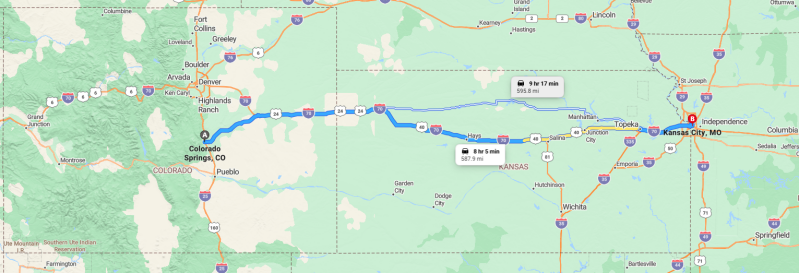
This was my route over the summer driving to Kansas City, Missouri
Take a look at the map above for a second. To give you context, this was the first leg of my summer road trip. As I was planning the stops I'd make along the way, I had to make decisions on how long I wanted to be on the road for the day as well. Of all the places I was visiting, I knew driving across Kansas was going to have some mental challenges when it came to staying awake. After all, it was only me in the car and it was up to me to keep myself awake. Music playlists and chewing gum only do the trick for so long. On a day like this one, I like to stay on my planned route as much as possible. For long days of driving, the interstate system comes in clutch. While it helps that you can go 75 miles per hour cruising down the open highway, the towns and cities along the interstate system are easy to pull off to and back onto the highway (for the most part). These towns usually boast roadside attractions for tourists to marvel at as well.
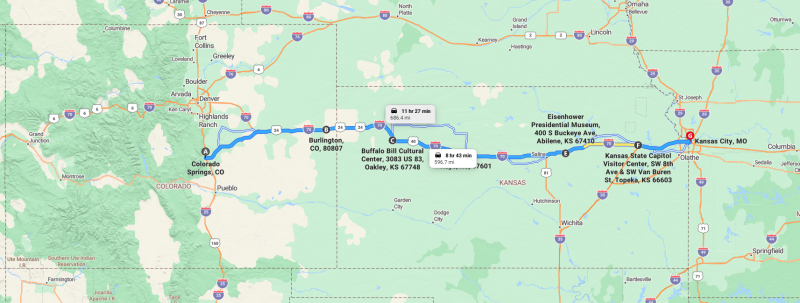
The route map with the planned stops for the day
If you look at the new map above, all of the markers between Colorado Springs and Kansas City were my stopping points. While the drive time says it's 8 hours and 35 minutes, the day as a whole was over 12 hours with one hour being lost to the time zone change from mountain to central shortly after entering Kansas. Aside from the first stop in Burlington, every other planned stop was less than two hours from each other. With the exception of Hays (which is being blocked by the car marker, my apologies), the three stops in Kansas were at places where I could get out of the car and walk. Museums, grocery stores or shopping malls, and parks are your best options for purposeful stops. By purposeful, I mean anything that's more than a quick stop and stretch, bathroom break, etc., that can be done at a gas station or rest stop. Those venues will not only get you out of a confined space in your vehicle, but you'll get a breath of fresh air being outside and the opportunity to walk around a *hopefully* air-conditioned building while getting the blood flowing to your legs again.
I suggested the venues above because they're things that are interesting to me. I know those venues and activities aren't interesting to everyone, but with the power of the internet it's easy for anyone to find anything that caters to personal interest along a route. When you have a long day of driving ahead of you, don't force time to go in your favor. That's the best way to deprive yourself of sightseeing. Sightseeing is half of the adventure of a road trip. At the same time, you don't want to plan too many quick stops or too many stops that are hours long. Too much of one or the other can unnecessarily extend your time on the road. If you don't have lodging reservations previously reserved, then multiple long stops won't matter if you're okay with stopping whenever you feel ready to.
What's the Best Way to Manage Time?
To manage your time effectively, you have to understand the power of balance. If you click on the Traveling Tips link at the top of the page, or in this paragraph, I broke down basic considerations in planning for a day on the road. Referring back to the map above, the distance from Colorado Springs to Kansas City is almost 600 miles. Bing Maps calculates the duration of drives by the average speed limit along the route, which is where the 8 hours and 35 minutes comes in. Obviously, no one is going to drive for 8.5 hours without making at least two 10-minute stops, which is an absurdly few number of stops for a long drive of this caliber.
My personal recommendation is to make one stop every two hours that's between 10 and 15 minutes at a minimum. Driving can be a mindless task the longer you're behind the wheel. Besides yourself, you have hundreds of other people to share the road with that you're responsible for keeping safe as well. If you stop regularly, it's harder for fatigue to take you over. That doesn't mean you won't feel fatigue at all, however. Everyone gets fatigued at some point, so listen to your body and don't push yourself more than necessary. It's better to get to your destination a few hours later than to cause an accident because you wanted to beat your expected time of arrival. Another safe practice to consider, especially if you're on the interstate, is to stop at every rest stop that's advertised. That might sound like a lot of stops, but typically interstates put rest stops about 60 miles apart from each other. That's roughly one stop every hour.
Aside from the one stop every two hours, it's very likely that along the route you will pass through a town that has a popular attraction. I plan one major stop on my routes prior to the trip. That one stop determines when I want to hit the road so that I can spend quality time at the stop. As for the other stops the rest of the day; I will look at a map of my route before I hit the road and see what's along the way, but I don't decide until I'm within a few miles of the area. When I left Burlington, I didn't plan to stop in Oakley until I saw the sign for the Buffalo Bill Cultural Center. I only stopped there because I was feeling fatigue and needed to walk around for a while before I continued. My main stop along the route was visiting the Dwight D. Eisenhower home and museum in Abilene, which was another three hours away. The Buffalo Bill Cultural Center was a perfect halfway point stop that wasn't too far away from the interstate 70 on ramps.
The other half of effective time management is deciding what time you want to be on the road. I left Colorado Springs around 6:30 AM on this day. I left as early as I did to avoid the morning work rush hour and driving too deep into the night. Avoiding nighttime driving is my personal choice, but one that can't always be avoided. I also took the time zone change into account and I wanted to be at the Eisenhower home before it was too close to closing time for the complex. Leaving when I did put me in Oakley by 11 and the Eisenhower complex by 2:30. After spending about an hour at the Eisenhower complex, I made another 20-minute stop at the Kansas State Capital grounds in Topeka before getting to Kansas City by dinner time, which was around six PM. It was a long day, but splitting up the 600 miles over a 12-hour period wasn't as exhausting as it could've been.
In summary, the three questions you need to ask yourself when managing your time on the road are as follows: how far I want to drive today, how often should I stop, and when do I want to be on and off the road today. Also, let yourself be flexible and spontaneous with time. You never know what you're going to see on the road that's going to make you want, or need, to stop.


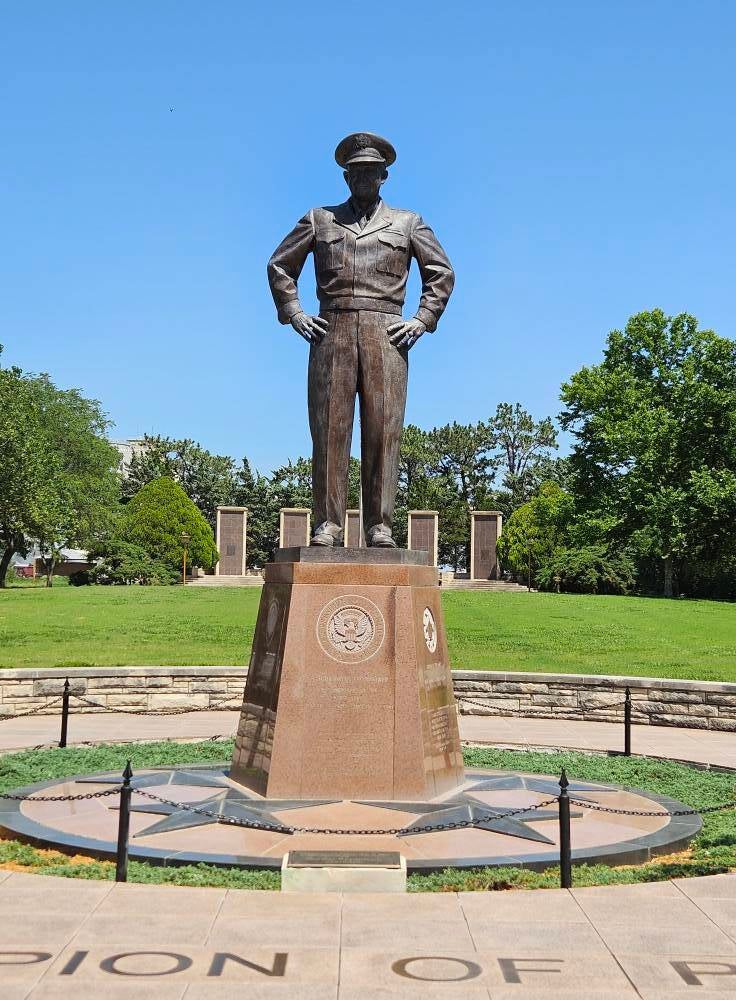
Top Left: Buffalo Bill statue at Buffalo Bill Cultural Center in Oakley, KS
Bottom Left: Eisenhower house in Abilene, KS
Right: Statue of Dwight D. Eisenhower at the Eisenhower home and museum in Abilene, KS
Enjoy the Adventure
This is the most important part of the trip that doesn't involve finances and vehicle maintenance. Enjoy the road ahead of you. Take your time and see all the things that you can see. Bask in the wonder of the world around you. Marvel at the unique attractions that make up a nation. Learn the history of the region and talk to locals. It's going to take you longer to get somewhere driving than it is to fly, and that's the beauty of the open road. Don't speed down the highway in as few of days as possible, yet don't move as slow as a snail to see every single blade of grass you pass. There is always going to be a reason to return somewhere, whether it be to see a site again or visit a site that was missed before. It's your journey and time is only a number.
Add comment
Comments